Why Is Bicycle LCD the Core Display for Modern E-Bikes?
Abstract
Modern electric bicycles rely on high-performance human-machine interfaces represented by Bicycle LCD to output stable and intuitive riding parameters, and qualified display components can effectively upgrade riding safety, manipulation precision, battery utilization efficiency and overall user experience; this paper comprehensively elaborates relevant core technologies, diversified classifications, raw material options, production assembly techniques, mainstream application fields, standardized selection rules, complete quality inspection specifications and dominant supplier strengths, offering practical reference for e-bike manufacturers, R&D engineers, bulk purchasers and after-sales maintenance personnel to pick matching display accessories and realize optimal vehicle performance configuration.
Table of Contents
- 1. The Role and Core Value of Professional Bicycle Displays
- 2. LCD Technologies and Structural Types
- 3. Module Packaging and Integration Processes
- 4. Typical Functions and Riding Benefits
- 5. Materials, Durability and Environmental Adaptability
- 6. Selection Criteria and Matching Suggestions
- 7. Quality Control and Testing Standards
- 8. FAQ
- 9. Conclusion
1. The Role and Core Value of Professional Bicycle Displays
Modern urban mobility and light electric vehicles demand highly integrated, low‑power, and sunlight‑readable dashboards. Bicycle LCD has become the dominant solution for electric bicycles, scooters, and lightweight mobility due to its ultra‑low power consumption, stable performance, and high cost‑effectiveness. Unlike simple LED indicators, a dedicated LCD provides real‑time, multi‑dimensional information including speed, mileage, battery voltage, assist level, error codes, and riding time, forming a complete human‑machine interaction system.
For daily riders, a clear display reduces visual fatigue and improves reaction speed, directly enhancing riding safety. For manufacturers, a reliable display lowers failure rates, improves product consistency, and strengthens brand image. For fleet operators and shared mobility systems, stable displays reduce maintenance costs and improve operational efficiency. The display is no longer an auxiliary component but a core module that determines the usability, safety, and durability of the entire e‑bike system.
As the electric mobility market expands globally, displays are evolving toward intelligence, customization, waterproofing, and wide‑temperature operation. Professional manufacturers are continuously optimizing liquid crystal materials, module processes, and structural design to meet strict requirements for outdoor use, vibration resistance, and long‑term reliability. Choosing a high‑quality display directly improves vehicle competitiveness and user satisfaction.
2. LCD Technologies and Structural Types
High‑performance bicycle displays use different liquid crystal technologies to balance readability, power use, cost, and durability. Each technology is designed for specific lighting conditions, viewing angles, and service life.
2.1 Main LCD Types
- TN (Twisted Nematic): Basic structure, low power, fast response, cost‑effective. Ideal for standard city e‑bikes.
- HTN (High Twisted Nematic): Better contrast than TN, wider viewing angle, suitable for mid‑range models.
- STN (Super Twisted Nematic): High contrast, stable in harsh light, good for outdoor and mountain e‑bikes.
- FSTN (Film Compensated STN): Ultra‑high contrast, black background effect, clear in strong sunlight.
- Black Mode LCD: Black background, high visibility, low reflection, premium appearance and durability.
2.2 Typical Product Models
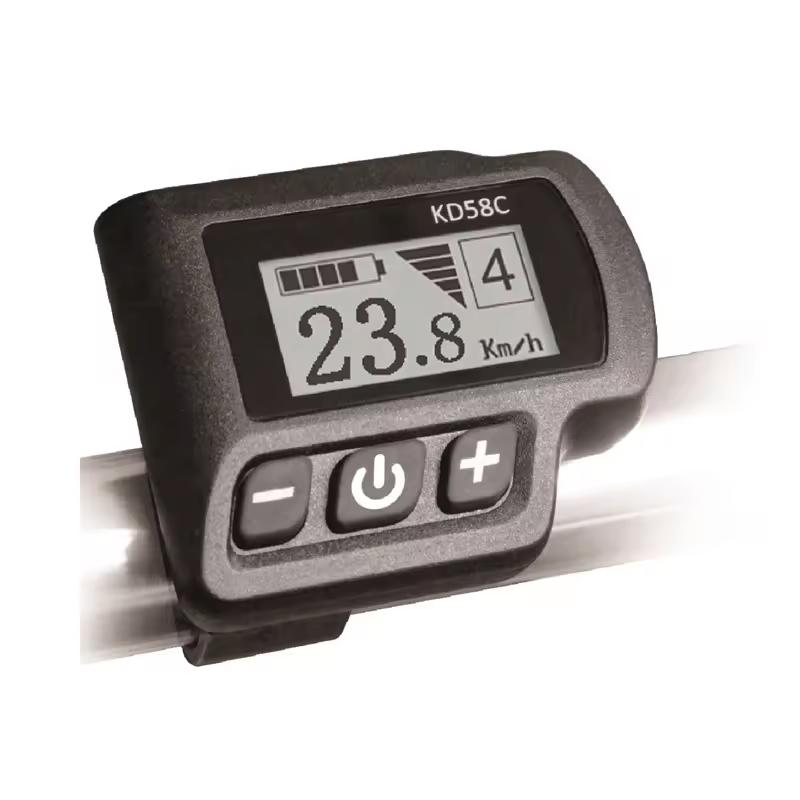
- KD58C: Compact segment LCD, clear speed and power indication, low power, widely used in city e‑bikes.
- S866: Multi‑function dashboard, supports assist levels, total trip, real‑time speed, and fault diagnosis.
Selecting the right LCD type depends on usage scenarios, cost targets, and appearance requirements. High‑end models often use FSTN or black‑mode displays for better outdoor readability and longer service life.
3. Module Packaging and Integration Processes
The reliability of Bicycle LCD depends heavily on module packaging technology. Professional manufacturers use advanced integration methods to ensure stability under vibration, moisture, and temperature changes.
3.1 Core Module Technologies
- COB (Chip on Board): IC mounted on PCB, high stability, strong anti‑vibration, ideal for rugged use.
- COG (Chip on Glass): IC directly bonded on glass, thinner, smaller, suitable for compact designs.
- COF (Chip on Film): IC on flexible circuit, high flexibility, good for curved or narrow spaces.
- TAB (Tape Automated Bonding): High‑volume production, stable performance, good for standard models.
3.2 Structural and Waterproof Design
Professional displays feature fully sealed structures, waterproof membranes, and tight housing assembly to meet IPX5–IPX7 waterproof standards. Internal circuits are protected by conformal coating to resist condensation and dust. The display can operate reliably in rain, high humidity, and high‑dust environments, ensuring long‑term stability.
4. Typical Functions and Riding Benefits
A professional display transforms raw data into usable riding information, greatly improving control, safety, and battery efficiency.
4.1 Core Display Functions
- Real‑time speed: Accurate km/h reading for safe speed control.
- Battery voltage/capacity: Prevents sudden power loss and extends battery life.
- Assist level indicator: 3–5 levels to balance speed and range.
- Single and total mileage: Helps plan trips and maintain vehicles.
- Error code diagnosis: Quickly identifies controller or sensor faults.
- Headlight control: Integrated switch for safer night riding.
4.2 User Experience Improvements
With a clear display, riders can adjust assistance in real time to optimize battery usage. High contrast and wide viewing angles ensure readability in sunlight or darkness. Waterproof and anti‑shock design ensures stable performance on rough roads. The display becomes a trusted riding companion that enhances safety, efficiency, and comfort.
5. Materials, Durability and Environmental Adaptability
Outdoor‑rated Bicycle LCD must withstand extreme temperatures, vibration, moisture, and UV exposure. High‑quality materials and strict processes ensure long life.
5.1 Key Material Features
- Liquid crystal material: Wide temperature range −20°C to +70°C, stable response.
- Glass substrate: Low‑expansion, anti‑shock, reduces cracking.
- Housing: High‑strength ABS or PC, UV‑resistant, anti‑aging.
- Polarizer: High‑durability outdoor film, sunlight readable.
5.2 Environmental Performance
Qualified displays pass wide‑temperature cycling, high humidity storage, vibration testing, and drop testing. They maintain clear visibility and stable function in rainy, snowy, dusty, or coastal environments. Such durability significantly reduces after‑sales problems and improves user trust.
6. Selection Criteria and Matching Suggestions
Choosing the right display requires evaluating technical performance, compatibility, reliability, and cost. Below is a practical guide for manufacturers and purchasers.
6.1 Core Selection Factors
6.2 Matching Suggestions by Vehicle Type
- City e‑bikes: TN or HTN, compact, cost‑effective.
- Mountain e‑bikes: STN/FSTN, IPX7, rugged housing.
- Shared fleets: High durability, waterproof, anti‑theft design.
- Premium models: Black Mode, integrated buttons, elegant look.
7. Quality Control and Testing Standards
Professional displays undergo strict testing to ensure reliability and consistency. Top manufacturers implement full‑chain quality control.
7.1 Key Testing Items
- Size and appearance inspection: No defects, uniform display.
- Electrical performance test: Voltage, current, function verification.
- Environmental testing: High/low temp, humidity, thermal shock.
- Mechanical test: Vibration, drop, push‑button durability.
- Waterproof test: Spray and immersion per IP standard.
Manufacturers with complete testing capabilities ensure stable batch quality and reduce failure rates. Compliance with international standards improves export competitiveness and builds user confidence.
Wenzhou Hoshineo Lcd-Tech Co.,Ltd. is a leading manufacturer focused on R&D and production of high‑performance displays. With advanced production lines, professional R&D teams, and strict quality systems, it provides stable, customizable solutions for global e‑bike brands. Products are widely exported to Europe, North America, and Southeast Asia, earning high trust for quality and delivery.
Another placement of Bicycle LCD comes into play when buyers source bulk orders for global e-bike OEM projects, as consistent specification directly affects final vehicle assembly efficiency and aftersales maintenance workload for downstream factories.
8. FAQ
Q1: Why are dedicated displays better than simple LED indicators?
A: Displays show multi‑dimensional real‑time data, are more readable outdoors, use less power, and support system diagnostics, greatly improving safety and user experience.
Q2: Which LCD technology is best for sunlight?
A: FSTN and black‑mode LCD offer the highest contrast and reflection control, remaining clear in strong sunlight.
Q3: Are displays waterproof?
A: Regular models reach IPX5; premium and mountain versions reach IPX7, safe for heavy rain and washing.
Q4: Can displays work in cold winter?
A: Industrial‑grade models operate from −20°C to +70°C, maintaining normal function in cold and hot conditions.
Q5: Can I customize logo, layout and interface?
A: Professional manufacturers support custom segment patterns, colors, housing, and connectors to match brand design.
For small batch importers, picking qualified Bicycle LCD cuts unexpected product return caused by screen failure or incompatible controller wiring during overseas sales.
9. Conclusion
As a core component of intelligent electric mobility, Bicycle LCD delivers real‑time data, improves safety, optimizes battery use, and upgrades overall riding experience. Its technology has evolved from basic TN to high‑performance STN, FSTN, and black‑mode solutions, supported by advanced COB, COG, COF, and TAB module processes.
High‑quality displays feature wide‑temperature stability, waterproofing, anti‑vibration, and UV resistance, meeting strict outdoor requirements. Choosing professional suppliers ensures stable quality, on‑time delivery, and customized support, enhancing product competitiveness.
As the e‑bike industry continues growing, displays will become smarter, more integrated, and more durable. Manufacturers that focus on technology innovation and quality will lead the global market, providing safer, more reliable, and more user‑friendly mobility solutions.
Many overseas brand designers confirm stable performance of qualified Bicycle LCD effectively lifts product market competitiveness in saturated European and North American e-bike markets.